Looks like the game is up for the short-lived Gen Con Southern California convention. That’s too bad–I hate to see California, land of my birth, deprived of such a cool geek event. Fortunately, from Peter Adkison’s letter, it seems that the Indianapolis Gen Con is still thriving. (Hat tip: Matt Forbeck.)
Monthly Archives: January 2007
Calling the Exterminator
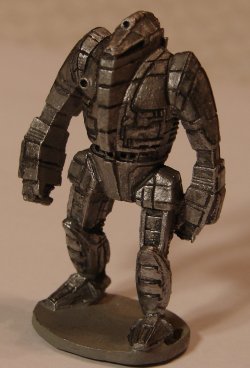
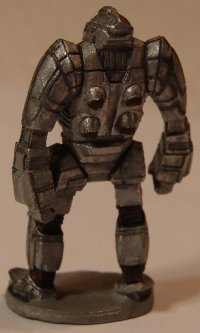
As you can see, I’m still learning the ropes. But here’s a front and back picture of Battletech miniature painting attempt #2, an Exterminator:
The lighting in the photos is not the greatest; in real life, there’s a slightly more prominent metallic sheen, and there’s some dark-brown undercarriage coloring visible. (You’ll just have to take my word for it.) I like this paint job a bit better than my previous effort, and I learned a few more things about miniature painting in the process.
As for the Exterminator itself, I’ve always thought its oddly bulky torso and shambling gait looked kinda cool. Reading around on the web revealed that it’s usually painted a shiny silver; the body here is silver in color, but I wanted its sparkly shine to be peeking out from beneath a heavy layer of battlefield smoke and grime.
Next up for painting is, I think, a Zeus, another iconic Battlemech. I think I’ll go with some brighter and cleaner colors this time; both the Dragon and the Exterminator are pretty grungy and washed-out looking, and I’m ready for a change of pace. Practice makes perfect, or so they say….
Free strategy games from the dark depths of the 80s
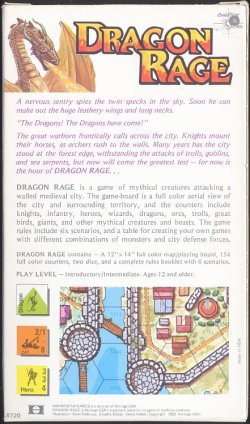
Ever heard of Dwarfstar Games? I hadn’t either, but it turns out they released eight rather quirky little strategy games in the early 1980s, all most of which are now available for free download. Most of them look like fairly short and straightforward strategy games, with an obvious wargame influence–the hexgrid maps and cardboard chits are a dead giveaway.
Downloading digital scans of the game maps and playing pieces isn’t quite as cool as actually owning the physical thing, of course, but for $10 or so at your local copy shop, you could probably recreate a fashionably old-school physical copy of the games. Might be a fun change of pace from all those new-fangled, high-production-quality games you kids are playing these days.
(More info and reviews of each game are available here. Spotted at Game It Yourself, which lists many, many other freely downloadable games.)
Tales of Gen Con
Here’s something interesting: a site devoted to the history of Gen Con, with a focus on personal stories from people who’ve attended during its 40-year history. It’s a cool idea. But how long must we wait before we get the sorts of stories we all really want to hear: the horror stories! It wouldn’t be a game convention if, in addition to all the fun stuff, you didn’t also have uncomfortably close encounters with guys dressed like Sailor Moon, or participate in roleplaying games with players whose grasp of the distinction between “player” and “character” is tenuous at best.
OK, I kid–actually, this little hobby could probably stand to focus a bit more on the many fun aspects of game conventions and a little less on the occasional scary parts. Either way, check out the Gen Con History site, and contribute a story of your own, if you’ve got one!
ASL + SFB = the apocalypse is imminent
Time to set the Doomsday Clock ahead another minute: the company behind Star Fleet Battles is hard at work on Star Fleet Assault, a ground combat game set in the Star Fleet universe. As I speak, the 400-page Star Fleet Battles rulebook and several Advanced Squad Leader tomes are weighing down a bookshelf in the living room, and I’ll admit I’ve fantasized once or twice about what sort of unholy hybrid abomination might result from combining the two into one Game to End All Games. When Star Fleet Assault comes out, I may finally have my answer.
In all seriousness: this sounds like a very cool game, at least from the preliminary description. The basic gameplay sounds less complex than that of ASL, although who knows what it’ll look like when all the optional rules have been added in. I’m particularly interested to see what sorts of ground combat vehicles exist in the Star Fleet Battles universe–that’s an aspect of Star Trek that’s hardly ever been touched upon.
In search of a certain undead Wallachian impaler: reflections on Elizabeth Kostova’s The Historian
Since I subjected you to my thoughts on vampires in my last post, I figured that I might as well share my specific thoughts on one of the two vampire-themed novels I mentioned: Elizabeth Kostova’s The Historian. Note: mild spoilers follow.
This is quite the ambitious novel: it’s a loose modern retelling of Dracula from the perspective of several generations of historians who are hunting for clues through letters, diaries, and manuscripts. The book’s narrator is the latest in a long string of historians to get obsessed with everybody’s favorite Impaler; and as the plot develops, she of course begins to suspect that Dracula himself is still lurking about causing mischief.
The good:
- Dracula (and vampires in general) are way cooler when they’re portrayed as terrifyingly evil supernatural villains, not angst-ridden, sexually-ambiguous Anne Rice antiheroes. Fortunately, Kostova paints Dracula and his ilk as unabashedly Evil, while avoiding any hint of “I vant to zuck your blood” campiness.
- The story is told largely through the medium of letters and manuscript excerpts from the Middle Ages to the modern day. For the most part, it works, and adds a lot of flavor to the story.
- Lots of cool details about life in early Cold War Eastern Europe. Definitely more interesting than the usual European History sites (Paris, London, etc.).
- Plenty of clever references to Stoker’s Dracula.
The bad:
- An overly sappy Hollywood ending sort of spoils the wonderfully melancholy tone of the book’s first 600 pages. The book almost manages to be a heartbreaking story of love and loss, as the curse of Dracula takes its toll throughout the lives and deaths of several interesting characters, but the ending doesn’t quite work.
- Most of the letters and manuscripts use the same voice and writing style, even when they’re supposed to be different people writing in different decades. It doesn’t kill the story, but it requires some extra suspension of disbelief.
- Perhaps this is just a feature of the Historical Mystery genre, but the plot involved an awful lot of this: Protagonists go to Site A, where they find a clue leading to Site B. They go to Site B, where they find a clue leading to Site C. They go to Site C… etc. etc.
All that said, this was a fun book. It’s not summertime right now–I am, in fact, trapped somewhere in the ice-encrusted depths of Michigan winter–but this would be a perfect summer read. More involved than your typical pop fiction, but not too weighty. With vampires!
Reflections on the living dead
Note: I don’t know where I’m going with this, but I feel like talking about vampires. You’ve been warned.
Call it the Year of the Undead, if you will. Thus far in 2007 I’ve read exactly two novels, and both of them were about vampires: Elizabeth Kostova’s The Historian, which was quite good, and Tim Powers’ The Stress of Her Regard, which was superb. I did not intentionally set out to read two books about the unquiet dead–I did not realize they had that subject in common until I cracked the covers–but I’m glad I did.
I’ve always found vampires to be fascinating, as far as unholy abominations go. I loved Stoker’s Dracula as a kid; Dracula served for years as the perfect model of the horror-story villain in my mind. He was cruel, vicious, and predatory; he was also patient, intelligent, and exceedingly clever. My favorite horror villains are those that simultaneously play on both existential and visceral fears, and Dracula did just that: on the one hand, he’s an unnatural, spiritually disturbing horror that casts doubt on everything we believe about life, death, and a benevolent God; and on the other hand, he’s a near-unstoppable physical threat that wants to punch holes in your throat with his teeth and suck the lifeblood from your body. (Other horror-story villains that fit this model are the creature from Alien, which I’ve discussed before, and Stephen King’s “It,” which manages to be both an alien cosmic horror and a child-eating evil clown that lives in the sewers.)
Dracula is a great, inhuman threat; he long ago shed what passed for his humanity. Stoker doesn’t do much to humanize Dracula, offering only a few tidbits through which to empathize with the vampire–most notably Dracula’s final smile (of relief, presumably) upon being staked and destroyed. Much has been made of the sexuality of Dracula, and while there’s certainly material in Dracula to fuel that interpretation, I never found it to be terribly interesting. Even if we subject Dracula to a lot of pop-Freudian analysis, the creature that emerges is most analogous to a sexual predator, and thus still belongs firmly in the category of Evil. That’s the way I liked my vampires: unrepentently evil, fated to be taken down in the end by a plucky band of heroes.
I avoided reading Anne Rice’s vampire novels for quite some time, knowing that they did away with the vampire-as-villain tradition and replaced it with undead who were angst-ridden, sexually ambiguous, and more or less sympathetic. When I finally got around to reading Interview with a Vampire, I was surprised at how much I enjoyed it. Interview, at least as I read it, retained (with lots of purple prose) the existential horror of the vampire condition but struggled with whether or not the vampire’s loss of humanity was a free choice or an inevitability. The vampire Lestat argues that the vampire’s undead state removes him from the reach of any moral limitations, whether they’re imposed by God or constructed by human society. The novel’s protagonist, the vampire Louis, feels the pull of this nihilistic philosophy but fights to retain his humanity. The idea that Lestat might be right–that vampires, removed from the possibility of grace, have no reason not to fully embrace their predatory instincts–lurks menacingly behind the story at every turn.
This is, behind the sometimes gratuitous and lurid surface of the story, the stuff of an old-fashioned morality play, and I found that it fit rather well with my vision of Dracula as an inhuman Evil. Dracula was a being who embraced the power of his vampiric state at the cost of his humanity and conscience. A vampire that refused to renounce his humanity would be, in a sense, not a true vampire at all, but a human being cursed with a particularly dreadful fate–not a villain.
Unfortunately, Anne Rice’s sympathies seemed to lie more with the nihilistic vampire Lestat and less with the tortured vampire Louis. The sequel to Interview stars Lestat, who is actually revealed to be a world-famous goth-rock star; I’ve never made it through this novel despite at least three attempts to finish it. My feelings about this were best expressed years ago by a Mars Hill Audio interviewee (I unfortunately forget his name) who remarked that without the backdrop of moral struggle, Rice’s vampires stopped being interesting characters and became ridiculous parodies of themselves: “superheroes with fangs,” I think may have been the phrase he used. At this point, we’ve moved well beyond the (intriguing, to me) stark morality of the traditional vampire and into some sort of post-modern silliness, and it’s here that I lose interest. In the end, I decided that while Rice’s take on vampires was a somewhat intriguing one, I really preferred the more black-and-white Evil Undead in the Stoker tradition.
Both of the books I mentioned above–The Historian and The Stress of Her Regard–feature vampires (or vampire-like creatures, in the case of Her Regard) that draw more heavily from the old-school Stoker-esque Dracula than from Rice’s morally-free undead. The Historian is the most straightforward about this, as it’s actually a book about Dracula. Her Regard features stranger and more complicated vampires, but they’re definitely alien and evil, at least by any human standard. To which I say: bring on the garlic, crucifixes, and wooden stakes! Those old-fashioned morally Evil vampires always were the most interesting kind, and I’m glad to see them cropping up after a decade or two of morally ambiguous undead.
Remembering Gettysburg! (the game, that is)
Last week I had the opportunity to attend a lecture by Jeff Shaara, author of several excellent Civil War (and other) novels. My interest in the American Civil War thus stirred up, I resolved to do something to capitalize on said interest. I’m not really into the Civil War re-enactment thing, and the movie Gettysburg, while an excellent film, seemed a bit too long and melodramatic at the time.
The solution? I dug through my computer desk drawer and found my old copy of Sid Meier’s Gettysburg!, a fine strategy game if ever there was one. I was a bit startled to learn that it’s nearly a decade old; and I was even more pleasantly surprised to find that it’s just as fun to play now as it was ten years ago. Meier is best (and justly) known for the Civilization series; but I happen to think that his game-design genius is just as evident in some of his lesser-known titles–games like Covert Action (if you remember that one, I salute you) and Gettysburg.
If ever there were a game that desperately needed to be remade today (with updated graphics and an improved interface, perhaps), it’s Gettysburg. The Civil War is generally only touched on by games that are set firmly in the hardcore-wargame genre; but Meier’s Gettysburg (and its follow-up Antietam) are so fun and simple to learn that anyone can be replaying the battle within fifteen minutes of installing it, even if you’ve never touched a wargame in your life. You don’t need to worry about memorizing your units’ attack ratings, tracking their remaining movement points, or dragging game pieces with obscure military symbols around a hex grid; Meier’s game is all about fast manuvers and outflanking the enemy before he does the same to you.
The game engine was even used, I believe, by BreakAway Games to create one or two Napoleonic battle games. Back when I was addicted to Gettysburg, I would’ve killed for a “Great Battles of the Civil War” collection using the same game engine. But alas; the Civil War has once again largely disappeared from the gaming scene. Matrix Games has recently released Forge of Freedom, but I think that’s about it as far as notable Civil War games go. (If you know otherwise, please let me know.)
It’s not easy to find a fresh copy of Gettysburg these days–your best bet is to pick up a used copy of the Civil War Collection–but if you should come across a copy and have even the slightest interest in strategy gaming, I highly recommend it.
History of the game
Over the last few months, Shannon Appelcline has been writing a column I’ve found really fascinating–A Brief History of Game, a history of some of the great companies of roleplaying history. Some of the great game companies of yesteryear are still around, while others are long dead and buried, but they all contributed something to the hobby.
Of particular interest to me was the two-part history of Iron Crown Enterprises (part 1, part 2)–that company was responsible for much of my gaming enjoyment when I first got into this hobby, and I’ve long tried to piece together from scattered internet rumors the details of their rise, fall, and subsequent rise again. Interesting stuff–and I’m glad somebody’s writing it all down for posterity.
Burning crusade… of nerds
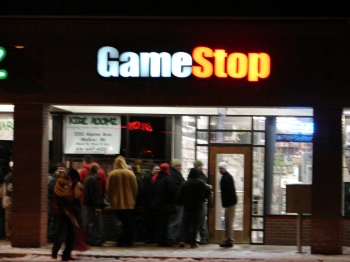
Where were you at midnight on Monday night? If your answer is anything other than “standing outside the local Gamestop in freezing-cold weather waiting to pick up a copy of the World of Warcraft expansion,” you’re a better person than I. Behold:
The lucky few at the front of the line. You can’t see him very clearly, but the guy in the bottom left is, indeed, dressed like a Warcraft character:
From my vantage point, way toward the back of the line. Who knew that this mid-sized midwestern town was home to so many WoW fanatics?

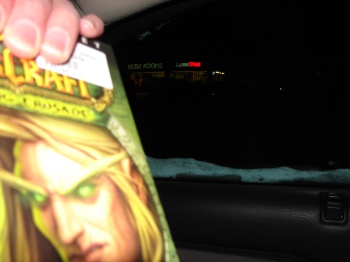
Victory at last! My copy of The Burning Crusade in hand, I drive home to fire it up and create a hot female blood elf character.

The experience of standing in line in the snow did not quite match up to Gamestop’s enthusiastic description of the event as a “release party.” I, at least, spent more time shivering in the cold and questioning my own sanity than I did actually partying. Nevertheless, I had a good time; it was fun interacting a bit with some fellow nerds in a social environment where conversation filler consists of questions like “So, is your druid spec’ed out as a feral druid, or as a healer?” rather than “So, mighty crazy weather we’ve been having lately!”