You know who else liked instinct?

What a surprise—Michael Moorcock didn’t like Star Wars either when it came out:

This sort of implicit paternalism is seen in high relief in the currently popular Star Wars series which also presents a somewhat disturbing anti-rationalism in its quasi-religious ‘Force’ which unites the Jedi Knights (are we back to Wellsian ‘samurai’ again?) and upon whose power they can draw, like some holy brotherhood, some band of Knights Templar. Star Wars is a pure example of the genre (in that it is a compendium of other people’s ideas) in its implicit structure — quasi-children, fighting for a paternalistic authority, win through in the end and stand bashfully before the princess while medals are placed around their necks.

Star Wars carries the paternalistic messages of almost all generic adventure fiction (may the Force never arrive on your doorstep at three o’clock in the morning) and has all the right characters. it raises ‘instinct’ above reason (a fundamental to Nazi doctrine) and promotes a kind of sentimental romanticism attractive to the young and idealistic while protective of existing institutions.

Look, buddy, if you’re going to bag on Star Wars, you have to be doing it for the right reason.

Star Wars, alongside Lord of the Rings, makes two genre-defining things that Moorcock hates (that is, considers “crypto-Stalinist”) which are are orders of magnitude more popular than Moorcock’s own writing. Oh, also “C. S. Lewis, Frank Herbert, Isaac Asimov and the rest.” I’m starting to detect a pattern.

Update: Moorcock (or the article transcriber) spells “Tolkien” incorrectly throughout his essay. So maybe he’s talking about a totally different Tolkien. Er, “Tolkein.”

Facebooktwitterredditpinterestlinkedinmailby feather

XP for death and failure; and other interesting uses for Experience Points

I recently came across an interesting post at Gothridge Manor about one of AD&D’s weirder rules: experience for death. The 1st edition Dungeon Master’s Guide rules that a character who dies and is subsequently brought back to life earns 1000 experience points (XP).

In old-school D&D, you generally got XP for defeating monsters and gaining treasure, with a few interesting exceptions like the above. These days, many games use a fairly abstract system of awarding XP wherein characters are awarded a set amount of XP for a combination of in-game success and good roleplaying.

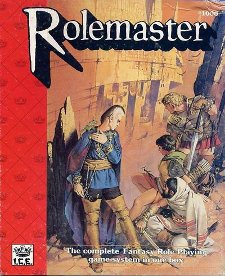
The cover of the 1989 Rolemaster boxed set.

That’s a fine way to do it. But the “experience for death” rule reminds me of the quirkier and much more ambitious method of awarding XP found in the pages of the Rolemaster RPG. Rolemaster, itself pitched as a more “realistic” take on fantasy adventuring than its contemporary AD&D, awards XP for extremely specific individual in-game actions.

For instance, in classic Rolemaster (2nd edition, and perhaps in other editions too), your character gains experience not just for defeating an enemy, but for each point of damage dealt to an enemy. And going beyond that, you gain experience for each critical hit (i.e., severe wound) you inflict. In fact, you get XP for each wound inflicted on you. (And yes, you get experience for dying and then coming back to life.) Outside of combat, you get XP for every mile your character travels and for every impressive physical maneuver your character pulls off. There are specific XP awards for casting spells and even for coming up with good ideas.

The paperwork is oppressive; even my nerdy junior-high gaming group, always eager to squeeze as much XP out of a gaming session as possible, usually failed to diligently record every single blow landed in combat for later XP calculation. These days I’m lucky if I remember approximately how many orcs the characters beat down in the course of an evening’s game; I can’t imagine filling out Rolemaster’s intimidating experience tracking chart, faithfully marking down the severity of each critical wound delivered in the course of a routine fight.

But this hyper-detailed system has its charms, and there are some neat ideas to be extracted from it even if you recoil from the detail:

  • Experience for failure. It might seem odd at first that your character would earn experience for being struck or seriously wounded in combat. If your character is getting slapped around in a fight, isn’t he “losing”? Perhaps, but consider the educational power of failure in life. In a combat situation, you might fall for a feint or sneaky manuver once, but assuming you survive said failure, you’re highly unlikely to fall for it again. You’ve learned a lesson you’ll carry with you into future combat situations.
  • Decreased experience for familiar accomplishments. Another neat little twist in Rolemaster is that your XP earned for accomplishing something—say, defeating a goblin—is multiplied by a different value depending on how many times you’ve accomplished the task in the past. If this is your first goblin kill, you get five times the normal XP for pulling it off. After you’ve taken out a few of the green nuisances, that multiplier value goes down; you’ve done this enough that you’re not learning as much from it. And when you reach the point where you can singlehandedly plow through an ocean of the luckless beasts, you’ve probably got the goblin-whomping down to a science and are getting 1/2 of its normal XP value.

All in all, I’m fine with the more abstracted system of awarding XP. D&D 4e’s method of assigning experience points to the entire group based on the difficulty of a particular challenge is probably close to my ideal. But I do sometimes miss the very detailed method, and the slightly unconventional uses of XP it allows.

Facebooktwitterredditpinterestlinkedinmailby feather

Guided tours of Bond, Holmes, and Lovecraft

I don’t know if it qualifies as a meme (or if the cool people are even still using that word), but Ken Hite started something nifty with his “Tour de Lovecraft” project. Hite read his way through H.P. Lovecraft’s stories and wrote up a short essay about each one—a combination of critical analysis and personal reflection. Although it started as a project on his blog, those essays have been published as a book (which I heartily recommend, should you ever decide to delve into Lovecraft yourself).

Now others have picked up that idea, following the same format with different authors:

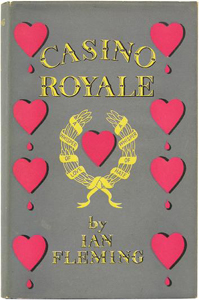
  • Tour de Bond: Gareth-Michael Skarka reads through Ian Fleming’s 007 novels. Very interesting if, like me, you’ve seen many of the Bond films but never read the stories upon which they were (often very loosely, it seems) based.
  • Tour de Holmes: Eddy Webb gives the Sherlock Holmes tales a similar treatment.

Both are well worth following. There’s something very appealing about reading a fan’s overview of their favorite series—it’s not “Everything Ian Fleming wrote ROCKS!!!!” fanboy gushing, but something more like “Here are the points at which Fleming really shines; here’s where he tripped up; and here are the elements that made me fall in love with his work.”

I really enjoy this “tour” format. It works well with short and/or serial literature of the Lovecraft, Holmes, and Bond variety. I’ve considered undertaking a project like this myself, but am unsure if I’d be able to stick with it.

Facebooktwitterredditpinterestlinkedinmailby feather

Stormbringer is mine!

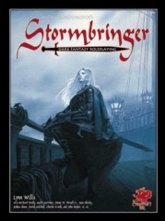
Elric poses with his soul-draining sword Stormbringer.

I had the chance to catch lunch with Ed earlier this week, and he was kind enough to pass an item from his game library to me: Stormbringer, the roleplaying game based on Michael Moorcock’s Elric of Melniboné novels. I’m really glad to get my hands on it; Stormbringer is one of those classic RPGs of which everyone speaks highly, but which I’ve never seen actually played. (But somebody must be playing it, as it’s in its sixth edition or thereabouts.)

In that sense, the RPG is not unlike Moorcock’s Elric novels: influential, well regarded, and yet strangely obscure. Although you might find a few Elric short story collections at the bookstore, the main Elric series that established the titular character as a pulp fantasy archetype seems to be weirdly out of print. If there’s any series screaming to be reprinted as an anthology, it’s the original Elric tales.

My own introduction to Moorcock and his angsty antihero came a few years ago when Elric of Melniboné turned up on my reading group’s list. I have since wondered how my youthful appreciation of the fantasy genre might have been different if I had gotten hooked on Moorcock instead of Tolkien 25 years ago. It’s too late now, of course; I was a Tolkien fanatic before I made it out of sixth grade.

And anyway, given my Tolkien partisanship, it’s probably just as well that I was blissfully unaware of Moorcock’s famous whinefest about Tolkien. (I like The Cimmerian’s rebuttal myself.)

But that aside, the first Elric novel is certainly worth tracking down and reading if you enjoy dark, morally edgy fantasy filled with strange and intriguing people, places, and gods. It’s sharply written and evocative, although angst-ridden Elric himself is probably one of those protagonists you either wholeheartedly love or hate from the moment you first meet him.

I hope to dig through the RPG in detail in the near future; but my initial take is that it’s an impressive piece of work.

Facebooktwitterredditpinterestlinkedinmailby feather

Yet with strange aeons…

For the last several years, I’ve blogged off-and-on at my dedicated game blog, The Lost Level. That’s been fun; but now I’ve also become interested in reviving this, my personal blog, again after several years of dormancy. To keep things nicely consolidated, I’ve merged the contents of my game blog with this one, and plan to continue posting here instead of there.

I have a sinking feeling that you can expect mostly game-related posts here for the foreseeable future, but you may once again get the occasional glimpse into the horror of my personal life as well.

So that’s why a hundred-odd new posts about games have appeared here all of a sudden. And why this blog has lurched abruptly out of its long-dormant state. Hope to see you around here!

Facebooktwitterredditpinterestlinkedinmailby feather

Making Man vs. Nature work in RPGs; or, nobody ever dies of scurvy in Dungeons and Dragons

Percy Fawcett went into the Amazon one last time, but he didn't come back.

In the last few months, I’ve read two riveting books about humanity’s drive to survive (and thus “conquer”) the most inhospitable environments on the planet. First up was The Lost City of Z, a historical account of the explorer Percy Fawcett‘s expeditions into the Amazon. The second was Dan Simmon’s The Terror, a fictionalized (complete with supernatural elements) account of the doomed Franklin expedition to find the Northwest Passage.

I thoroughly enjoyed both books, different as they are, and found myself utterly engrossed in the almost impossibly difficult struggles to survive in environments where man was clearly not meant to tread. In both cases, the natural environment is so inimical to human life that it is perceived by the survivors/victims as possessing an active, malevolent desire to destroy them.

It makes for gripping reading. But being a gamer, it also made me wonder why Man vs. Nature struggles, so compelling to read as narratives, are so rare in roleplaying games.

My instinctive reaction to a typical Man vs. Nature conflict as a roleplaying episode is that it would be rather boring, although I’m not immediately sure why that is. There is nothing about game rules that would stop you from putting together a survival scenario like the ones described in the two books above. Consider the roleplaying actions a sea-based arctic survival scenario would involve:

  • Successfully navigate your ship through icy waters and avoid getting lost or trapped in the ice.
  • Send expeditions out to hunt for food, often hunting dangerous animals (think polar bears).
  • Avoid scurvy and disease.
  • Keep party morale up and put down mutinees as needed.
  • Jury-rig shelter and equipment to stay alive.
  • Repair continual damage inflicted on your ship by the environment.
  • Avoid going mad yourself.

Trust me, getting eaten by a troll is a much better fate than scurvy.

Each of those could be broken down into discrete, accomplishable roleplaying activities; most games have skills and rule systems that would accomodate these activities. So why don’t more games feature environmental survival as the core challenge? Why doesn’t that sound more fun?

In most RPGs I’ve played, weather, environmental danger, and survival are abstracted into a few modifiers or die rolls done on the side—and usually just to find out if you’ll suffer any combat penalties from starvation or snowy terrain. Or else the challenge of survival is represented by a handful of “environmental challenges” that you overcome once and then get on with the scenario’s other, more interesting challenges. The handful of games I’ve played that featured straight environmental challenges (like the iceberg-scaling in “The Trail of Tsathoggua” for Call of Cthulhu) were actually kind of boring. The players rolled dice, occasionally took damage or suffered a penalty when they failed a roll, and then we got on with more interesting stuff. There was neither much tension in the challenge nor a meaningful sense of accomplishment upon overcoming it.

Have you ever run a game that featured explicit environmental challenges that really worked? Have you ever made the challenge of simply surviving something that was as tense and entertaining as an epic battle or other more traditional roleplaying challenge? How did you do it?

Note: for a related discussion, see Justin Achilli’s thoughts on the concept of exploration in games. I think a big part of a successful exploration-based game would be getting the “survival” part down solid, since part of the historical allure of exploration is the challenge of surviving in the strange new environment you’re exploring. And I think it’s telling that genuine exploration and environmental survival aren’t prominent in most published RPGs.

Facebooktwitterredditpinterestlinkedinmailby feather

Behind the scenes of Planescape: Torment

Via Gnome’s Lair, a great interview with Chris Avellone on Planescape: Torment. Lots of interesting tidbits here, although if you haven’t yet played through the game, there are some spoilers:

[youtube=http://www.youtube.com/watch?v=MWEl0IQm670&fs=1&hl=en_US]

Well worth reading in conjunction with this interview is Avellone’s original vision document for PS:T (massive spoiler warning this time). It’s interesting to compare the vision document to the finished game.

Facebooktwitterredditpinterestlinkedinmailby feather

The walls of this 10×10 chamber are adorned with…

When my wife and I finally made the choice to became real Americans (i.e. go tens of thousands of dollars into debt to buy a house), one of my requirements was that said house have some sort of subterranean chamber which I could convert into a basement game room. One year later, my game lair is finally ready.

Of course, no game room is complete without cheesy posters adorning the walls. No longer being 13, I can’t get away with supermodel pinups or Megadeth posters. But this is a perfect excuse to dig out those vintage game posters I’ve been hauling with me around the country for the last two decades. After a few trips to Hobby Lobby to pick up some cheap poster frames, here’s what’s hanging on the walls of my game room. (I apologize for the flash glare in some of these… if my game room had adequate lighting, it would not be authentic.)

First up is a pair of (unfortunately fairly weathered) Battletech Mech schematics, bought way back in the early days of FASA:

Battlemaster

The 85-ton BLG-1G Battlemaster. Awww yeah.

Warhammer

The infamous Warhammer, complete with two PPCs and a cheesecake illustration of Natasha 'Black Widow' Kerensky in the bottom right (for scale purposes, of course).

On the opposite wall, découpaged to an oh-so-classy piece of wood, is the map that came with one of my favorite Infocom games, Beyond Zork:

Quendor map

I love this map, although I could do without the dozen compass roses pasted across it.

And now back to Battletech. The only Commodore 64 game I played as much as Wasteland was Battletech: The Crescent Hawk’s Inception. It was my introduction to Battletech, and ever since, the poster that came with it remains the iconic Battletech image in my mind:

Crescent Hawk

A tiny Locust mech faces off against... what is that, a Marauder? That's not very fair, but it looks awesome.

Moving along, we have (surprise) another Infocom poster, this one of one of their least-known games: Quarterstaff: The Tomb of Setmoth. It was a quirky RPG/text-adventure hybrid (and only available on the Mac, strangely); but I really enjoyed it back in high school.

Quarterstaff

Am I the only person who played and enjoyed this game?

No game collection in the late 80s/early 90s was complete without at least one SSI Gold Box AD&D game. Here was mine:

Champions of Krynn

Champions of Krynn, one of many SSI Gold Box classics.

The next item is a change of pace: a poster that came with one of my favorite NES games, Dragon Warrior. This game was surpassed not long after its release by Final Fantasy I, but was a great deal of fun. And it has one of the most annoying/awesome catchy soundtracks of any NES-era game.

Dragon Warrior

One of the first great JRPGs on the NES.

And last but not least, I devoted most of an entire wall to one of the most iconic locations in D&D: Undermountain, the megadungeon. I framed three of the four maps that came in the 2e Undermountain boxed set:

Undermountain maps

There are a LOT of places to die in Undermountain.

So that’s what’s hanging on the walls of my basement game lair. I like to think of it as inspirational artwork. And believe it or not, there’s a stack of maps and posters that I’ll have to put back in storage because there wasn’t room to frame them too….

Facebooktwitterredditpinterestlinkedinmailby feather

My love-hate relationship with random encounter tables

Of all the skeletons in my GMing closet, perhaps the darkest is this: I almost never use random encounter tables, even when running games with a deliberately “old-school” vibe.

Why do I ignore this staple of roleplaying? Well, my experience with using random encounters can be summed up in these two memories, both of them from my early days of GMing.

Random encounter #1: the best thing ever. When I first started GMing (with Middle-Earth Role Playing, which was a trimmed-down version of Rolemaster), I followed to the letter all of those rules that, in later years, I learned to sometimes skim over: encumbrance, travel times, and—yes—random wilderness encounters. For one of our first-ever games, I ran the “Ar-Gular’s keep” adventure included with the MERP rulebook. Faithfully following the rules for wilderness travel, I rolled on the random encounter chart to see what, if anything, would happen while the party of 1st-level adventurers set up camp.

I rolled, did a double-take at the result, but never even considered “cheating” by ignoring what was almost certainly going to be a total-party kill: a troll.

In Middle-Earth, trolls are nasty. The party, caught unawares while they camped, was almost certainly going to die. But the encounter chart said TROLL, so a troll it was. (This was the Trollshaws, after all.)

A frantic, panicky combat ensued. Things were not looking good for our heroes. And then, in a stroke of awe-inspiring luck only possible when you’re using Rolemaster’s glorious critical hit charts, one of the characters did the impossible: with one frenzied jab of his sword, he killed the troll.

It was, as they say, a one-in-a-million roll, one that turned a nearly-certain party massacre into the most memorable possible introduction to roleplaying. And it would never have happened if I had massaged the random-encounter results or picked out a “balanced” encounter.

This was followed by another random encounter.

Random encounter #2: the worst thing ever. A few months later, the characters had been through many adventures in Middle-Earth and were coming into their own as true adventurers. One character, an elf ranger, had after much heroic toil reached 3rd level (dizzying heights of glory, from our perspective). I was growing more confident in my GMing abilities, and so when the player asked to head off on his own on a personal quest, I heartily agreed.

I spent time designing an adventure around his character’s backstory and goals. Accompanied by a few NPC henchmen, he set off on his quest, which took him through a vast swampland.

I faithfully rolled for random encounters as he journeyed through the swamp, and sure enough—he ran into an obstacle: an alligator. A regular alligator, not a Dire Alligator or a Sauronic Minion Alligator. Figuring that a quick battle against the reptile would get the action going (what is an alligator going to do to a noble elf warrior?), I set the beast loose against the player.

You can guess what happened. A few unbelievable dice rolls and several profanity-filled combat rounds later, the party was dead and the noble elf, hero of Middle-Earth, was bleeding out from a severed leg. With no help anywhere in range, this mighty Noldor, distant heir of Feanor, creator of the Silmarils in an Age long past, bled to death in an alligator attack straight out of late-night TV.

Remember that epic scene from Lord of the Rings where the Fellowship is mauled by a random alligator? Yeah, neither do I. Because that would be stupid.

It seems silly in retrospect, but at the time it was a severely frustrating experience. The player had spent months building up his character and it had all been thrown away not with an epic fight against the Dark Lord’s minions, but with a random and meaningless alligator attack. And the time I had put into adventure prep designing a quest tailored for his character were rendered rather pointless.

I realize now that there were plenty of things that both I and the player could have done differently to avoid stupid, non-heroic reptilian death. But the lesson I learned was that random encounters, while they had the potential to be memorable and entertaining, also had the potential to spoil a game session. Having seen random encounters used to good effect in games like Rogue Trader, I’m starting to accept that they do add something challenging and exciting to a game. These days I make use of what you might call semi-random encounters: encounters rolled randomly but then adjusted a bit for balance or storyline coherence.

But while the memory of that epic troll kill still warms my heart, it will be a while before I put my complete trust in the random encounter table again.

What about you? Do you adhere to random encounter results… and have you ever lived to regret it?

Facebooktwitterredditpinterestlinkedinmailby feather