Monthly Archives: August 2006

Remembering Tony Jay

Earlier this month, voice-actor Tony Jay passed away from cancer. Chances are you’ve heard his voice in a video game at some point in the last decade; his IMDB page lists out the various projects to which he lent his very memorable voice.

I first read about Jay after playing Planescape: Torment (which boasted an unusually high quality of voice acting all around). I was quite impressed by the voice of The Transcendant One in that game, and wanted to find out who had played that role. Since then, I’ve noticed his work in quite a few different games–he has a deep baritone voice that’s impossible to miss. Rest in peace, Tony, and thanks for contributing your voice-acting talents to our little corner of the universe.

Facebooktwitterredditpinterestlinkedinmailby feather

Why Battletech and Star Fleet Battles rock

Jeff Rients has a great post about what makes Battletech and Star Fleet Battles so much fun to play. They’re two quite different games, but they share some traits that have kept them popular even 30+ years after they first hit the market. Jeff hits on a couple points I hadn’t considered, one of which is that the wonderfully complex record sheets can make even losing in these games an enjoyable activity.

Facebooktwitterredditpinterestlinkedinmailby feather

Behind the scenes: archaeology

As you may know–I’ve been whining about it to everyone who will listen for the better part of a week now–my wife is in Turkey, where she’s unearthing priceless artifacts on an archaeological dig. The site she’s at is Zincirli, a Hittite city that was last excavated in the late 19th century by the German Oriental Society, which sounds pretty Rosicrucian to me. Your “history” books won’t tell you that Zincirli is where they unearthed the Spear of Destiny, but what else would the Ratzis have been doing way out there?
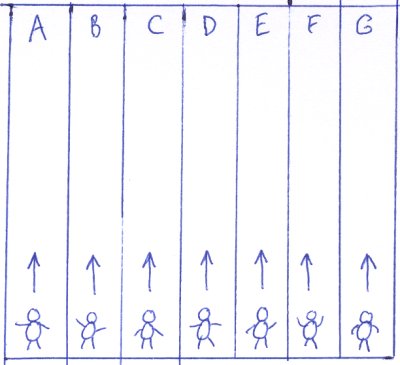
Ahem. It sounds like one of the main tasks that Michele’s team is doing out there is surveying the site to pave the way for full-blown excavation in the future. I am not entirely a stranger to archaeological surveying, and had the opportunity to do it once at the Umm el-Jimal dig in Jordan (when I wasn’t busy scrubbing potsherds with a toothbrush). To survey the site, we divided the (very large) area we wanted to cover into several long rows. A team of two people was assigned to walk along each of these rows, mapping out interesting terrain features and collecting pottery therein:


The idea was that at the end of the day, everybody would return to camp with a detailed map of one strip of land, which could be combined with everybody else’s maps to create one big map of the area.
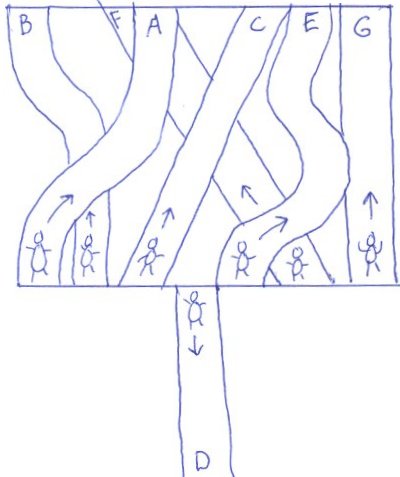
Unfortunately, this plan makes some rather unwarranted assumptions about the the ability of the average undergraduate volunteer, even one equipped with a compass and other navigational aids, to walk in a straight line. At the end of the day, when everybody turned in their maps of the strips of land they’d surveyed, the pieces upon being put together looked something like this:

I love the field of archaeology, but it’s worth keeping in mind that the latest sensational archaeological claim you just read about might have been based on the enthusiastic but non-linear survey work of, well, someone like me, who counts himself lucky if he manages to walk down the hallway of his own apartment without careening into the walls.
But if surveying this plot of land will foil whatever scheme Jerry is cooking up…. well, then, get out there and do your duty, soldier!
update: I’m told that, as of this post, the Zincirli Wikipedia entry was woefully inaccurate. More Templar disinformation? Ah, the perils of Wikipedia.

Facebooktwitterredditpinterestlinkedinmailby feather

“Say it again or I’ll break your other wrist”: thoughts on 24

Over the last several months, Michele and I have gotten hooked on the TV show 24. We’re on the last disc of season 4; at this point, I believe that I’ve seen enough of the show to offer the following observations:

  • This show features more “red-shirted ensigns” than all the Star Trek series combined. Whenever Federal Agent Jack Bauer heads off on a mission and decides to bring with him the hitherto-unknown Agent McGivens, you can be sure that Agent McGivens’ sole purpose is to take the first bullet and thus warn Jack that the bad guys are present.
  • At any given time, approximately 45% of the staff at Counter-Terrorist Unit headquarters (where Jack works) is in the direct employ of the bad guys. Next time there’s a terrorist threat, the most effective possible response would be for CTU to immediately arrest all of its own employees and start questioning them. Eventually, one of the many traitors will spill the beans and save Jack precious hours’ worth of skulking around Los Angeles hunting terrorists.
  • Are you romantically involved with Jack Bauer? Are you related to him? Are you his boss or a coworker? Perhaps you dated him in high school, or competed against him at a spelling bee in the fifth grade? I’m sorry to tell you this, but: for the rest of your (short) life, you and everybody you know will be routinely kidnapped, shot, stabbed, held for ransom, blackmailed, beaten, chased, tortured and killed by Jack’s innumerable enemies. (And sometimes by Jack.)
  • CTU is utterly incapable of defending anything from anyone. About every other episode, the following exchange takes place at CTU headquarters:

    Jack: Where’s Kim? You said you’d keep her safe while I was out in the field! Tell me where Kim is or I’ll break your arm!
    Coworker: Take it easy, Jack. She’s totally safe. She’s at the Incredibly Secure Safehouse, and I sent Agents McGivens and VanNeuwenHeisen with her. They’re pros, Jack, you know that.
    Jack [looking relieved]: OK. Thanks.

    What we, the audience, can glean from this conversation is: Agents McGivens and VanNeuwenHeisen are already dead, the Safehouse has been quite thoroughly ransacked, and Kim is once again in the hands of the terrorists. That is, assuming she even got to the safehouse, which brings me to my next observation:

  • If you are traveling to or from CTU headquarters, there is a 75% chance that your vehicle will be ambushed and you will be kidnapped. Whenever somebody says something like “Kim? Oh, she’s on her way back to CTU,” you may assume that her car has already been ambushed and she is once again in the hands of the terrorists.
  • Terrorists: have you captured Agent Jack Bauer? Have you beaten him around a bit, handcuffed him to a pipe somewhere in your hidden base, and left him there while you attend to more pressing matters? My friend, I hate to tell you this, but he has already escaped, acquired heavy weaponry, killed most of your minions, transmitted the location of your base to CTU, called in an airstrike and a SWAT team, and is right now taking aim at you from his hiding place in the ventilation shaft directly above your head.
  • The one sentence you really don’t want to hear from Jack: “You don’t have any more important information, do you?”
  • And last but not least, a final message to would-be terrorists: Jack Bauer is in Los Angeles. Do yourself a favor and find another city upon which to unleash your dastardly schemes.

Jack Bauer, we love you… and we’re a little scared of you.

Facebooktwitterredditpinterestlinkedinmailby feather

Drawing moral lines in wargaming

One of the first events I attended at Origins this summer was a small roundtable discussing the topic of ethics in gaming. How should one approach dark, evil, or morally ambiguous themes in a roleplaying game? Of the three forum participants, I recognized two as having written game material that would have, back in the Old Days of gaming, sent Jack Chick into an apoplectic frenzy; so naturally I was interested.

It was, indeed, an intriguing discussion that showed me a few new ways to think about the topic. While I’m not usually one to explore Dark and Mature Themes in my roleplaying games (no matter how hard I try, my Call of Cthulhu games usually end up as pulpy, tongue-in-cheek affairs), it is heartening to see that behind the surface-level shock value of, say, a game supplement about satanism, there is an author who is fully aware of the ethical territory into which he’s ventured, and who is determined to handle the topic responsibly. Of course, not all game authors approach gray moral issues with such care, but I have renewed respect for those who do.

One of the most interesting points brought up during the discussion, however, was that ethical issues can crop up even in types of games we don’t normally think of as dark or controversial. One of the presenters–Ken Hite, I believe–pointed out that players can run into moral quandaries even in a area of gaming like historical wargames–a genre I’d generally perceived as so clinical in its approach to its subject matter as to leave little room for shades of gray. Hite mentioned a wargaming friend who refused to play the side of the Confederacy in any wargame (presumably because of its support for slavery, although I don’t think Hite specified). For this player, no matter how historical, detached, or neutral the game’s approach, taking on the role of the Confederacy was a moral line he was unwilling to cross.

Normally I might not have given this point much consideration. I enjoy historical strategy and wargames, but I’ve rarely thought of them as having an ethical edge–I’ve never seen anyone object to playing the Germans in Axis and Alies, and wargames that deal more closely with ethically-blurry conflicts (such as wargames about the Arab-Israeli wars or the German-Russian front in World War II) are careful to focus purely on the clash of military forces, avoiding the atrocities and war crimes that sometimes accompanied them.

All that to say, I’m not accustomed to viewing the hobby of wargaming as an activity with serious ethical elements. But the very next day at Origins, I was surprised to find myself catching a glimpse of that moral line–in Advanced Squad Leader, of all things. The final game I played in the small Origins ASL tournament was a scenario called “Mila 18”–depicting a Jewish revolt in the Warsaw Ghetto in 1943. One person controls the poorly-armed but determined Jewish fighters, while the other player controls the SS troops sent into the Ghetto to crush the revolt by killing and rebels and “mopping up” the Ghetto’s buildings.

Now, I suspect that the Mila 18 scenario is intended as a salute to the bravery of the Jewish fighters who rose up to fight the Nazis against overwhelming odds. (It certainly isn’t any sort of glorification of the SS.) But it felt vaguely uncomfortable to control the German troops–and not just generic “German troops,” but a specific historical SS unit–sweeping through the Ghetto carrying out a mission that was evil by any objective standard.

Why did it make me uncomfortable? Under ordinary circumstances, I have no moral qualms about simulating historical military actions on the board of a wargame, however brutal those battles were in real life; but the looming shadow of the Holocaust cast this scenario in an entirely different light. Although I played out the scenario to the end (the Germans lost), I didn’t like pushing those little SS markers around on the gameboard. Does a scenario like Mila 18 cheapen the memory of the real-life sacrifice and murder that took place there–and if so, why does it prompt moral discomfort when a scenario about, say, the Normandy invasion does not? Or is this scenario an important, maybe even critical, reminder that no matter how far we try to distance ourselves from the real horror of the wars we clinically simulate, there remains a serious ethical element to wargaming?

In the end, it’s a game and a hobby, and I probably won’t lose sleep over it. But I think it’s healthy to periodically stop and consider where our ethical boundaries lie, even for something like gaming. And I’m always up for a good game of Advanced Squad Leader, but next time I think I’ll stick to more uplifting parts of the war–like the Eastern Front, or the Pacific War, or… ah, never mind.

Facebooktwitterredditpinterestlinkedinmailby feather