The story: “L.T.’s Theory of Pets,” collected in Everything’s Eventual. First published in 1997. Wikipedia entry here.
Spoiler-filled synopsis: A blue collar man named L.T. recounts a humorously embellished account of his failed marriage to his wife, Lulu, and the role that their pet dog and cat played in breaking up the marriage. What L.T. studiously avoids mentioning in this bittersweet reminiscing is that Lulu was murdered by a serial killer shortly after their breakup.
My thoughts: This is an odd one. It’s not odd that King occasionally takes a break from the horror and suspense genres—most of his short story collections contain one or more tales that deviate from the gruesome norm. This story is odd because it’s unusually paced, and because after a lighthearted, comical, and touching tale of a marriage that didn’t quite work, it ends on a surprisingly dark note.
King writes in a foreword to this story that “L.T.’s Theory of Pets” is in part an experiment in lowering the reader’s guard and then striking while they’re emotionally vulnerable. And he’s reasonably successful in doing so: despite a few vague hints early on that there’s a darker context to the story, King lulled me into complacency with L.T.’s flavorful recounting (to the story’s narrator, a friend and coworker) of his marriage’s final year. L.T. and his wife Lulu may have been in love, but they just don’t seem to have been destined for a successful marriage. Childless, they buy each other pets (a dog for L.T. and a cat for Lulu) as gifts; comically, L.T. and Lulu wind up hating “their” pet but becoming attached to their spouse’s. Their building irritation with their spouse’s pet serves as a proxy for and reflection of their frustrations with their own marriage, until Lulu finally picks up and leaves.
L.T.s account, which takes up the bulk of this short story, is reasonably fun. King tries to emulate the speech mannerisms of a modestly-educated meat-packing plant worker, and the result is a mildly humorous story in the vein of Dave Barry: the usual gags about men leaving the toilet seat up and the like. L.T. comes across as an unappreciative husband and Lulu as a flighty wife; we’re a bit sad but not especially surprised when Lulu leaves.
In the story’s final pages, however, things take a turn for the bleak: Lulu left L.T. to move back in with her mother, but never made it. While her body was never found, it seems certain that she fell victim to the “Axe Man,” a serial killer preying on women in the area. The narrator of “L.T.’s Theory of Pets” muses that L.T.—who still loves and misses his wife, however annoying she was—is unable to accept this reality, and uses his oft-repeated story of a marriage ruined by pets as a mechanism of denial. Wracked with sorrow and guilt (Lulu wouldn’t have died if he hadn’t driven her out, after all) L.T. clings to the hope that Lulu is out there somewhere alive and well.
As I said, an odd story. I was waiting for L.T., or the story’s narrator, to be revealed as the Axe Man, but King doesn’t take that route. In that sense, it’s nice to be surprised. And I always enjoy King’s depictions of married relationships; he relates with insightful clarity the ways that spouses love and exasperate each other. Whether this all hangs together as a good story once you add the discordant tone of serial murder to the mix, I’m not sure. I respect the effort to emotionally disarm and then ambush the reader, and to branch out from King’s usual fare. But the slightly goofy account that takes up most of this story isn’t strong enough to bear much narrative weight, and the combination of I Love Lucy-style yuks and murder doesn’t work all that much better than L.T.’s marriage.
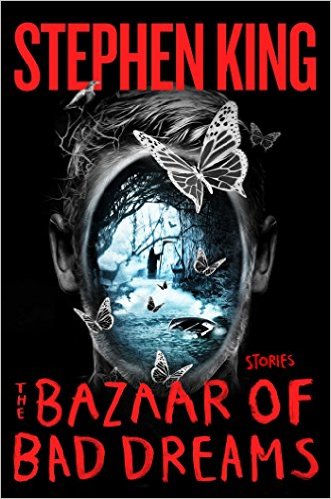
Next up: Let’s jump back into some straight-up horror with “Bad Little Kid,” from The Bazaar of Bad Dreams.


 by
by 





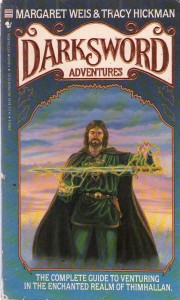 I have a big collection of roleplaying games—far too big, I’m reminded every time I venture into the basement room where it resides. With a few exceptions, my collection doesn’t contain anything terribly rare or valuable (the games in my library that would command the highest prices from collectors also happen to be the ones I played to death over the years, so they’re far from mint condition). But I do have a good number of oddities nestled amidst all the predictable D&D tomes. I came across one of them today while rearranging the family bookshelves.
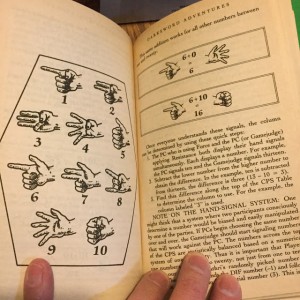
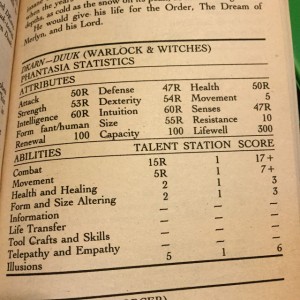
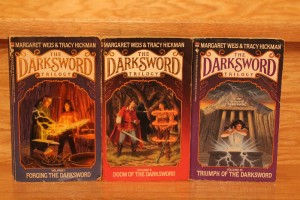 The Darksword series is set in a fantasy world called Thimhallan. Its central gimmick is that everyone in Thimhallan is a magician of sorts, able to tap into a Force-like source of magical power and employ it to do things that would otherwise be done with machinery and technology. In fact, mechanical devices and anything (or anyone) that operates on principles other than magic are considered to be “dead” abominations. The hero of the series is a man born “dead”—unable to use magic. There are ancient prophecies, annoying “comic” sidekicks, noble sacrifices, a depressing ending, and other stuff you’d expect from a 1980s fantasy saga. It’s not going to dethrone Tolkien anytime soon, but it was appealing enough for high-school-aged me.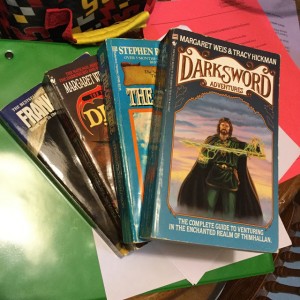







 Whelp, the the aforementioned hiatus has continued. The “busy and distracting” elements I vaguely referred to in my last post actually turned out to be a medical condition the details of which I will spare you; but which has made it difficult to do much of anything in the evenings. Most of the time, when I get sick, a part of me is excited about the prospect of being forced to stay in bed and reading. However, I’ve at last met my match in a medical condition which keeps me from being able to read for any significant length of time.

 My thoughts: Short, simple, and fun, “Battleground” isn’t the sort of story that invites deep reflection or discussion. There’s just something wonderfully appealing about the thought of a troop of

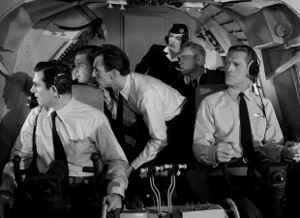 Spoiler-filled synopsis: A handful of passengers on a red-eye flight across America wake up to find that the rest of the passengers—and the plane’s crew—have vanished into thin air. They manage to land the plane (one of the group is a pilot), only to find that the world is gray and dead—they have gone back in time, but it turns out the past is an empty shadow of the present. And strange creatures called the langoliers, who “tidy up” history by literally devouring the past, are headed their way.

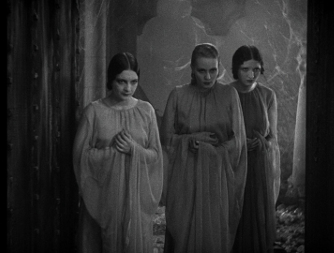 My thoughts: Another vampire story! “One for the Road” is best read as an epilogue to the (excellent) vampire novel ‘Salem’s Lot; without that context, it loses much of its impact. Whether or not you read it in connection with that novel, however, this is a short, simple story that belongs to the “Want to hear about something spooky that happened to me?” around-the-campfire genre. It all builds to the vampire encounter in the final pages—a conclusion that is telegraphed from the story’s opening pages but is nonetheless creepy and tense when it unfolds.
